Every operation has a drill. Not always a drill — a laptop, a two-way radio, a set of van keys, a defibrillator on a wall. Something that costs real money, gets shared between people, and moves through the day faster than anyone thinks to write it down.
Ask a supervisor where a specific one is, right now, and you tend to get a sequence rather than an answer. A pause. A guess. A phone call. Eventually a name — and the name is often wrong. Not because anyone was careless, but because the information was never written anywhere. It lived in someone's head, and heads don't scale past about four items or one shift, whichever ends first.
The cost is easy to underestimate, because it never arrives as a single bill. It's the twenty minutes three people spend looking. It's the second drill bought because the first one "walked". It's the job that waits because the only working scanner left an hour ago in someone's car. None of these show up in a budget line called "not knowing where things are", so nobody defends against them.
A sign-out sheet is only as good as the worst day of the person holding the pen — and the worst day is exactly when you need the record.
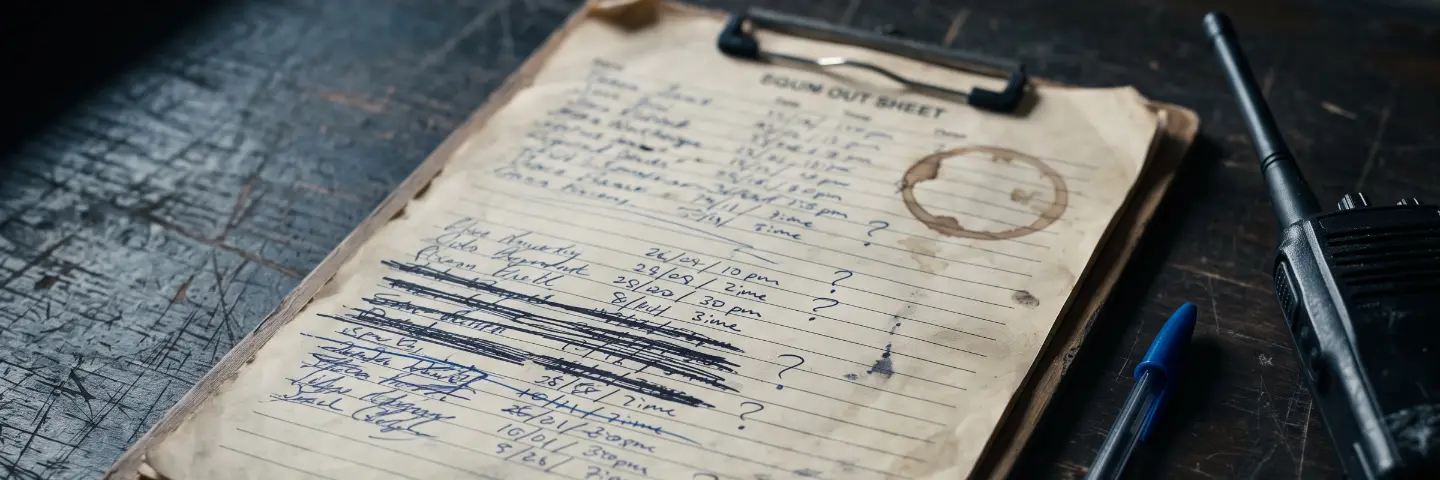
The instinct is to blame people, and to reach for a clipboard by the door. Sign-out sheets work for about a week. They fail for a boring reason: they ask the busiest person, at the busiest moment, to stop and write neatly. Goodwill is not a system. It's a thing you spend, and it runs out first on the days that matter most.
What works instead is making the record a by-product of the handover rather than a chore laid on top of it. When giving someone the drill is the same action as recording that they have it, the record stops depending on anyone trying harder. You don't get a tidy log because everyone was disciplined; you get it because there was no other way to hand the thing over.
And once that's true, a second thing appears that the clipboard never gave you: history. Not just who has the drill now, but who had it last, and before that. The question stops being an interrogation and becomes a lookup. The drill that "always goes missing" turns out to go missing on the same route, through the same two people — which is a solvable problem, not a character flaw.
This is most of what GearLogs does, and why it looks the way it does. Handing something out, taking it back, assigning it to a person — each is one action that lands on a shared record the moment it happens, colour-coded and searchable, with the history kept. The point was never the software. The point is that "who has the drill right now?" stops being a question you dread, and becomes one you answer without looking up from your desk.