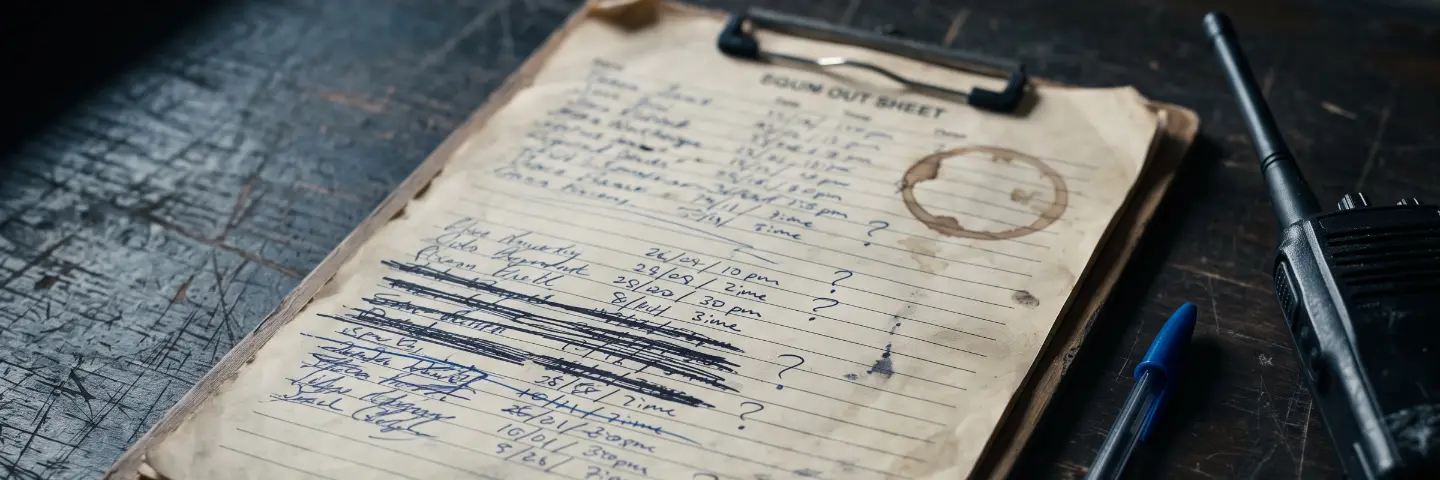
Every organization that issues equipment runs some version of the same system: a person takes a piece of gear, and someone writes it down. A signature on a hand receipt. A name in a sign-out column. A quick message to the storeroom. It works — right up until the moment someone asks a simple question and nobody can answer it: who has this, right now?
That question is what "chain of custody" actually means for physical equipment. Not the forensic-evidence version you'll find most places online — the everyday version: an unbroken record of who has held a piece of gear, from the moment it was issued to the moment it came back. Each hand-off is a link. The chain is only as strong as the weakest one.
Paper hand receipts and sign-out sheets break at predictable places. A signature is illegible six months later. There's no timestamp, so "when" becomes "sometime around then". When a person leaves, the paper trail leaves with them. And the one detail that matters most in a dispute — what condition the gear was in when it changed hands — almost never gets written down at all.
A hand receipt proves that someone signed. It does not prove who has custody today.
A custody record that holds up captures four things at every hand-off: who, what, when, and the condition at the moment of transfer. Miss any one of them and the record stops being able to answer the question it exists for. "Who signed for it in the spring" is not the same as "who is accountable for it now".
There are three custody events worth getting right, because everything else is a variation on them. Issue: gear leaves stores and becomes one person's responsibility. Hand-off: it moves from one person to another without passing back through stores — the event paper is worst at capturing. Return: it comes back, and someone records the condition it came back in. A system that records all three, automatically, can still answer questions after the people involved have moved on.
This is also the first thing any audit or investigation asks for. When a piece of equipment is missing, damaged, or in dispute, the opening question is always the same: who had it last, and what shape was it in? An organization that can produce that history in seconds is in a very different position from one reconstructing it from memory and a box of paper.
The practical test for any digital custody tool is whether the trail survives the things paper can't: personnel turnover, the passage of time, and disagreement about what happened. That means timestamped records, condition captured at each transfer, history tied to the individual item rather than a batch, and an export you can hand to someone who needs to verify it.
This is most of what GearLogs is built to do. Custody isn't a signature you hope to still read later — it's recorded automatically at every issue, hand-off, and return, tied to the individual unit, and kept as history that outlasts the people who created it. The question stops being an interrogation and becomes a lookup.